Category: Uncategorized

  • Inflation, Deflation, and the Question Bitcoin Forces Us to Ask

    Inflation, Deflation, and the Question Bitcoin Forces Us to Ask

    There is a strange tension in modern life that almost everyone feels but few can articulate.

    We are more technologically capable than at any point in history, yet life feels harder. We are more productive, yet less secure. We are told we live in the most advanced economy ever built, yet the basics — housing, family formation, time — feel increasingly out of reach.

    This is not an accident.

    And it is not a mystery.

    At the centre of it all is inflation — not as a statistic, but as a moral force.

    Inflation Is Not Just Rising Prices

    Inflation is usually described as a technical necessity, a modest side effect of a complex system. That framing is misleading.

    Inflation is the debasement of money over time. It is the erosion of stored effort. It is what happens when money no longer faithfully represents the work that produced it.

    When prices rise faster than wages, life becomes more expensive in time. You must work more hours to buy the same future. That is not a neutral outcome. It is a transfer — from savers to debtors, from workers to asset holders, from the future to the present.

    Inflation allows governments to run permanent deficits without immediate consequences. It is politically convenient precisely because its damage is delayed, dispersed, and difficult to trace.

    That delay is the problem.

    Money Is a Proxy for Time

    Money is not wealth in itself. It is stored human time.

    When you work and save, you are deferring consumption — banking hours of your life for later. When money is debased, that stored time decays. The work still happened. The time was still spent. But its ability to carry forward into the future has been reduced.

    This is why inflation is so corrosive. It doesn’t just make things more expensive — it breaks the promise between effort and reward.

    And once that promise breaks, trust breaks with it.

    The Confusion Around Deflation

    At this point, someone usually objects: “But deflation is dangerous.”

    This is where language obscures reality.

    There are two very different things that get called deflation.

    One is demand collapse inside a debt-saturated system, where falling prices make fixed debts harder to service. That is genuinely destructive — but it is a symptom of structural fragility, not a law of nature.

    The other is productivity-driven deflation — the cheapening of goods and services through efficiency, technology, and innovation.

    This second kind of deflation is not only benign, it is the entire story of human progress.

    From tools to agriculture, from industry to software, civilisation advanced by making essentials cheaper in human time. We learned to do more with less. Life became easier because we got better at producing what we needed.

    If technology improves and productivity rises, yet prices must still increase for the system to function, then something is wrong. The gains of progress are being intercepted before they reach ordinary people.

    That interception is inflation.

    Deflation is only considered “dangerous” because our current system cannot tolerate honest prices without collapsing under its own debt.

    That is not an argument against deflation.

    It is an indictment of the system.

    The Shape of the Dystopia

    The dystopia people fear is not a dramatic collapse. It is far quieter than that.

    It is:

    smaller homes longer working hours delayed families permanent insecurity lowered expectations presented as realism

    There is no moment where things “break.” There is only gradual acceptance that life should cost more and deliver less.

    This is why the damage is so difficult to resist. It arrives disguised as normality.

    And it is why inflation is not merely an economic issue. It is an ethical one.

    A society that systematically makes the future worse than the past — by design, not by accident — is failing a basic moral test.

    What Bitcoin Actually Is (and Isn’t)

    Bitcoin is often framed as an investment, a speculative asset, or a political statement. None of those descriptions are precise enough.

    Bitcoin is best understood as a monetary refusal.

    It refuses:

    monetary expansion by decree debasement to cover deficits trust in authority as a prerequisite for saving

    Bitcoin does not promise prosperity. It does not guarantee fairness. It does not fix every structural problem.

    What it does is simpler — and more radical.

    It restores money as stored time.

    No committee can dilute it. No emergency can override it. No future promise can quietly borrow against it.

    That is not ideology. It is constraint, encoded.

    Can Bitcoin Prevent the Dystopia?

    No.

    A society cannot asset-allocate its way out of moral failure. Bitcoin does not build houses, reform education, or make political systems courageous.

    If only a minority adopt it, the broader trajectory can continue unchanged — with inequality simply expressed in a new form.

    But Bitcoin can do something important.

    It can allow individuals and families to opt out of the mechanism of theft.

    How an Individual Uses Bitcoin to Refuse the System

    Bitcoin works when it is used boringly.

    Not as a trade.

    Not as leverage.

    Not as a gamble.

    But as time preservation.

    In practical terms, this means understanding life in layers:

    Fiat for survival — bills, food, obligations Bitcoin for savings — long-term, untouched, patient Skills and resilience — because stored time only matters if you can still earn

    Debt matters here. Inflation turns debt into servitude. Bitcoin and high leverage do not mix.

    Volatility matters too. Bitcoin removes smoothing and manipulation. Price swings are not a flaw — they are the absence of lies. Anyone who cannot tolerate that volatility will sabotage themselves.

    Bitcoin does not remove effort. It removes decay.

    The Intergenerational Dimension

    Bitcoin’s most important feature is not personal gain. It is intergenerational honesty.

    It allows people to save without being forced into speculation.

    It allows effort to reach the future intact.

    It allows children to inherit stored time rather than starting from zero in a system that resets every generation.

    That is not utopian. It is modest. And it is profound.

    What Bitcoin Will Not Do

    Bitcoin will not:

    make life easy remove inequality eliminate hardship replace work or meaning

    It offers optionality, not comfort.

    It amplifies discipline and punishes recklessness. It exposes character rather than compensating for it.

    Bitcoin does not save people from themselves.

    The Real Question Bitcoin Forces Us to Ask

    The most uncomfortable thing about Bitcoin is not its volatility or its politics.

    It is the question it makes unavoidable:

    Why must money decay for society to function at all?

    If we are truly becoming more productive, more capable, more efficient — why must the future always pay more for the same life?

    Bitcoin does not answer every question.

    But it makes one thing clear:

    Inflation is not inevitable.

    Debasement is not natural.

    And theft does not become moral just because it is slow.

    Bitcoin is not a promise of utopia.

    It is a refusal to accept quiet decay as the price of modern life.

    And sometimes, refusal is where change begins.
  • The Entrepreneurial Seizure chapter 1

    The Entrepreneurial Seizure chapter 1

    The interview was a weird one.

    Mark Peters sat off to the side.

    His wife sat directly across from me.

    At the start of the interview Mark said it might seem a bit strange, but his wife would be asking the questions, and I should answer directly to him — not her.

    The interview took place at Mark’s house in Canford Heath, Poole.

    The position: trainee bathroom installer.

    I remember some banter about the signwriting on the side of his van. It was a blue Volkswagen Transporter with a cartoon woman sitting in a bath. The unusual thing was that supply-and-installation fixed prices were listed on the side. I had never seen that before, and it gave the whole thing a very commercial feel.

    Maybe that was the point.

    Maybe Mark Peters wanted the company to look bigger than it was.

    “How should you leave a customer’s house after you’re finished?” he asked me.

    I said you should leave it as you found it.

    “Better than you found it,” he replied.

    I didn’t get the job.

    Maybe that’s why. I’ll never know.

    What I do know is that as I walked out, I looked at the vans parked outside his nice house and thought to myself: If you can’t join them, beat them.

    That interview stayed with me longer than I realised.

    Later that year, on an autumn Saturday morning, Sting and The Police played quietly through the stereo of an RS Turbo. Matt never played music too loud when he drove — and for good reason. We liked to hear the wastegate hiss as he changed gear.

    “Don’t stand so, don’t stand so, don’t stand so close to me — fsssshh.”

    The RS wasn’t just transport.

    Metallic purple. Lowered. Alloy wheels. Body kit. Whale-fin spoiler. Not done on the cheap — thousands had been spent on it. A real show-stopper. Not the kind of car you normally saw twenty-year-olds driving. This was Max Power magazine territory.

    The routine was simple.

    Cruise around on a Saturday morning. Offer lifts to girls. Invite them out to Poole Quay that night on a pub crawl. Rinse and repeat.

    There was no Tinder back then. In some ways things were harder — you had to do everything face to face. But in other ways, things were easier. People couldn’t just look you up online. If they thought you were interesting, numbers were exchanged. If not, you’d never see them again. Curiosity worked in your favour.

    The only problem was that it wasn’t Matt’s car.

    It was Colin Spencer’s.

    Colin had been working with his dad as an apprentice plumber since the age of sixteen, right at the height of the plumber shortage. As a result, Colin was flush. He lent the car to Matt most weekends because Matt was better looking — and far more successful with the pickup routine.

    Matt and I were the front end of the sales funnel.

    Colin would appear further down the line on the pub crawl.

    On this particular ride, our passenger was Nikki — a twenty-four-year-old police officer I’d met at the Brass House the week before. She was four years our senior. I was counting the seconds until we dropped her off at Fleetsbridge Tesco.

    The unspoken truth was that Matt wasn’t insured to drive the RS.

    You could have cut the tension with a knife.

    We pulled into the Fleetsbridge Tesco car park. I hopped out and swung the front passenger seat forward to let Nikki out. She couldn’t have weighed more than fifty kilos and almost floated up out of the car, weightless.

    “Thanks for the lift — text me,” she said, flicking her straight platinum-blonde hair back as she walked off.

    I looked at Matt.

    “Thank fuck for that,” he said.

    We both cracked up laughing.

    Nikki turned back to see what was so funny, and Matt and I froze — like a pair of kids just rumbled by a teacher.

    Matt’s dad was an electrician who dabbled in kitchen and bathroom refurbishments. Matt worked with him on electrical jobs, but he was keen to carve out his own path as a ceramic wall tiler.

    I don’t think there was any sound business reasoning behind it. It felt more like the classic case of a son wanting to do something different from his father — to become independent as quickly as possible.

    I was working as a jobbing plumber, but I didn’t have my gas registration.

    As I explained my idea of starting a bathroom refurbishment business to Matt, it felt like the obvious route to go down. A bathroom is, after all, mainly a plumbing and tiling job.

    Two entrepreneurs were born over a full English breakfast.

    Or so we thought.

    We weren’t entrepreneurs at all.

    We were technicians suffering from an entrepreneurial seizure.

    An entrepreneurial seizure is what happens when someone who does technical work — a mechanic, a hairdresser, a tradesman — assumes that because they can do the work, they know how to run a business that does that work.

    The hairdresser thinks that because she’s good at cutting hair, she should run a hair salon, without realising that running a business requires an entirely different set of skills.

    Most self-employed people will tell you they own a business.

    They don’t.

    What they own is a job.

    A business is a money-making organisation that produces profit whether the owner turns up or not. If it requires the owner to be present and doing the technical work, it isn’t a business — it’s employment with extra risk.

    Many of these jobs will never become businesses because they aren’t scalable, and the technician doesn’t understand how to build one. They just keep working harder, doing everything themselves.

    What Matt and I didn’t realise was that we were about to start one of the least scalable and least profitable businesses you could imagine.

    Looking back now, after more than twenty years in business, I can see that Bathroom Solution couldn’t have been a worse business model even if it had been designed that way.

    In practice it meant long hours and hard work for very little profit. Responsibility sat with me at all times — the money, the quality, the mistakes, the stress. I was never able to switch off. Even when I wasn’t working, I was thinking about work. And despite all of it, there was no obvious way to expand. The ceiling was low and visible.

    What made it worse was watching other people make money in businesses that didn’t seem to demand the same level of effort or sacrifice. They weren’t working harder than me — they were just positioned better.

    I’d often heard people say, “A restaurant will never go out of business — people always need to eat.”

    That’s an example of a business with repeat custom.

    MOT centres. Hair salons. Plumbers doing annual boiler services.

    Revenue compounds in those businesses. Once a customer is acquired and satisfied, they return. New customers stack on top of old ones. The business grows without having to start from zero each time.

    Bathroom refurbishments don’t work like that.

    They’re projects that happen once every ten or twenty years. By the time a customer is ready for another one, they’ve usually moved away — or lost your number.

    For Bathroom Solution, customers didn’t compound. Every job meant starting again from scratch. That meant constant spending just to stand still.

    I didn’t understand any of this at the time.

    I just believed that if you stuck at something and worked hard enough, it would succeed.

  • How to fix the U.K. housing market

    “How do I get on the property ladder?”

    1. It isn’t a ladder.
    2. It’s an overblown liability (it’s not an asset) — just like a car or a laptop.

    The populist idea is that immigration is responsible for house prices rising relative to income, but this isn’t true at all. Immigration has its own problems, but house prices aren’t one of them. The supply of housing has risen at roughly the same rate as the increase in population. The thing responsible for soaring house prices is liquidity. Back in the 1970s, you went to the bank and borrowed 2.5x your yearly income. Today, we’re talking about 5x your income and 50-year mortgages. You’re basically buying two houses for the bank and one for yourself.

    Notice how new car prices are crazy now?

    I bought a brand-new Vauxhall Vivaro van for £14,000 in 2008.

    Now I’d be looking at £40,000.

    Why?

    Because we buy cars using finance. People are addicted to buying status symbols. They pay through the nose, but it all feels manageable because the showrooms offer finance. Instead of investing in their financial freedom, they pay £400 a month for the car. A better option: buy a 2016 Kia Picanto for £500. It will last 10 years. Put the £400 a month into investments.

    Want to know how to fix the housing market tomorrow?

    Remove the leverage.

    If the government announced that the lending rate was 1.5x income only, the housing market would crash fifty percent overnight.

    But nobody wants that.

    Champagne socialists.

    Everyone is following comrade “tax the rich” Gary Stevenson while voting for more quantitative easing to push up house prices and inflation — which is a tax on the poor. The heroin-addict “property” owners just want the number to keep going up, and they don’t want to fall into negative equity. Never mind the fact that their children and grandchildren will never be able to buy a house. The problem isn’t capitalism. The problem is socialism. Our money isn’t tethered to anything tangible, and endless money printing by a central entity devalues our currency and pushes up the cost of buying a house.

    In real terms, houses didn’t go up.

    Measured in ounces of gold, house prices are lower now than they were in 1970.

    In 1971, we came off the gold standard with the end of the Bretton Woods agreement.

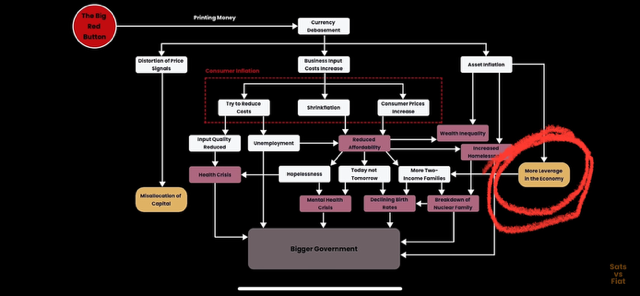
    Since the end of the Bretton Woods system, every measure of human existence has gone down the toilet. This is because everyone gets a yearly pay cut as the currency is inflated towards zero, while house, food, and energy costs go through the roof. Two-parent households become a necessity, and the nuclear family breaks down due to stress — leading to worse outcomes for kids, more reliance on benefits, all paid for by the big red button of money printing.

    If you want, I can also rewrite this as a tighter, punchier version for social media while keeping the same message.

    There’s a way out though.

    Bitcoin.

  • Bitcoin Batman of Bedford

    “Bought Bitcoin at 102,000 dollars when it’s 92,000 dollars now — rather stupid move by Saylor.”

    In response, I pointed out that people said this when Saylor bought at 10k, 15k, 20k, 40k, 60k, and 80k. Every single time, people called him an idiot.

    We call retail investors “dumb money.”

    This is because they usually rush into Bitcoin to buy the top, and then they panic sell the bottom when the price drops. It happens every time. When an asset reaches a euphoric high, the public are queued around the block ready to buy it. Then when the inevitable correction hits and the price drops, they panic and sell the bottom. They wanted a quick buck — instead, they get a quick loss.

    Traders think they can time the market by buying the bottom and selling the top.

    It hardly ever works. Best case scenario, they break even.

    Notice how traders sell trading courses?

    Why?

    Because they have to make money somehow, that’s why.

    99 percent of people who trade lose money, and the one percent who make money would have made the same amount if they had simply held the asset instead of being glued to a screen 24/7 like Gollum staring at the ring. “My precioussss… stop loss.”

    This reminds me of Angry Mike. One of my ex-wives had a friend who married a guy called Mike. He was in the U.S. Air Force and did a trading course when he left. $100,000 of their savings burned and 36 smashed keyboards later, Mike realised that the only people making money in trading are the ones who sell the courses — and value investors who can spot a product that will always be in demand and just buy and hold it.

    Like real estate — but better.

    Bitcoin is one of those things.

    What purpose does it serve?

    Imagine you lived in Ukraine and all your money was tied up in your house. As in, you put down a large deposit — basically all your savings — and now your house is a pile of rubble. That’s not ideal, is it?

    What if you stored your wealth in gold bars in your basement? Well, that’s getting confiscated, isn’t it? If it isn’t stolen by Russian or Ukrainian soldiers — or simply someone bigger than you — it’s getting taken at the Polish border.

    But you could memorise your Bitcoin seed phrase and walk across the border with a million dollars’ worth of Bitcoin stored in your head.

    You’re probably thinking: “But I’m not in a Ukrainian war zone.”

    True.

    But what if you decide you want to move abroad at a moment’s notice?

    A house is a ball and chain that goes up about 3 percent a year nominally (losing value in real terms).
    Gold is a ball and chain that goes up around 4 percent nominally (also losing value in real terms).

    Bitcoin is a bank in your head that goes up an average of 50 percent a year.

    Smart people know this.

    People like Peter McCormack. On a recent podcast (https://youtu.be/Mpi4HY564gs), Ant Middleton asked Peter if he trusted the government with his finances. Peter said he doesn’t — he keeps all his money in Bitcoin. With an annual income well over seven figures, that’s quite a bit of Bitcoin. In fact, holding his wealth in Bitcoin is what enabled him to buy a football club.

    Peter is also sick to the back teeth of the crime in his local town of Bedford, so he’s set up his own private police force and pays for private security to police Bedford town centre. This earned him the headline “The Bitcoin Batman” in the Daily Mail:
    https://www.dailymail.co.uk/news/article-14963919/Bitcoin-Batman-save-Bedford-Former-cocaine-addict-turned-crypto-millionare.html

    Although I disagree with the headline “Crypto millionaire.”

    Pete wouldn’t invest in shitcoins.

    Bitcoin, not crypto.

    There is no second best.

  • How simon Squib really made it

    You’ve probably seen Simon Squib on social media.

    “Have you got a dream?”

    He walks up to people to people in the street and asks them if they have a dream. He listens to the dream and then sets them a little challenge. (Normally a first step to make the dream come true) If Simon thinks they’re investable, he simply asks them how much money they need, and then throws a wad of cash at them.

    It’s punk rock Dragons Den.

    Simon is a massively successful entrepreneur who sold his last company for several hundred million. Check him out on instagram.

    Simon Squib

    Simon bought his first house (Mansion) for cash at the age of 47.

    Why?

    Why not sooner?

    Because he knows property is a shit investment and he’s spoken about this on podcasts.

    His first business was a gardening business. Not a man and van type situation. His gardening business was quite large with many employees. He sold it for a fair bit as a going concern and this was the stepping stone to bigger things. But loads of people have gardening businesses and they never get beyond one employee on the books.

    So what did Gary do different?

    1) He kept his costs low and lived in a shed rent free.

    2) He reinvested the profits

    This enabled him to pile what he would have been paying in rent or mortgage payments back into the business. A strategy he would use over and over.

    Most people can’t do that because they hand half of their earnings over to the bank or landlord.

    The crazy part:

    Most people are just 5-8 years away from never having to work again.

    Instead, they spend 30-40 years chained to a mortgage and pay it off just in time to have to sell the house to live off the equity. (If they’re lucky)

    Then they die.

    Do you need a business?

    Hell no.

    In fact, I wouldn’t advise it. Most businesses fail because we are trained all the way through school to be employees, and because there are plenty of businesses already.

    So just invest in an already profitable business.

    Apple, Tesla, Microsoft, NVIDIA to name a few.

    Live like a tramp, then invest like someone is holding a gun to your head and if you’re not a centi millionaire within 5 years the trigger gets pulled.

    Sounds simple right?

    It is simple, but it’s not easy.

    Most amateur investors buy the top and sell the bottom. When investements drop, they panic and sell at a loss and then jump to the next investment. You need to reverse those emotions and pick the right things to invest in.

    All explained in Nomad investor

    (Invitation only)

  • Property investment, the sacred turd

    Most people you speak to think that being a landlord and owning a property business is the “be all end all” of investing.

    Funny part is that it’s the worst.

    People just follow the herd.

    It’s a bit like the “Eating fat will give you a heart attack” thing that took decades to die. A simple bit of misinformation that ended up written in stone. The sheep pick a direction and then lock onto that path come hell or high water. It takes decades for them to change course. Property is the worst investment you can make. I know this only too well and I’m glad I’ve got rid of my property business.

    Why?

    Because aside from all the headaches involved with tenants and maintenance, property (housing) hasn’t gone up in fifty years.

    The price increase you see on a house is purely a result of the devaluation of the pound. A house hasn’t gone up in value; the pound decreased in value so it takes more pounds to buy the house. Measure the price of the house in a real money like gold and you find that the average family home could be bought for 2kg of gold in 1970.

    Today, measured in gold, house prices have gone down.

    This shows what a terrible investment houses are when you consider that gold isn’t even the fastest horse in the race by a long shot. Some consider it the baseline from which to measure the increase of an asset. You will often hear things like:

    “Wages haven’t risen in real terms.”

    This means that if you got a 4 percent pay rise but the thing you got paid in (the pound or dollar) decreased in value by 10 percent, you got a nominal pay rise of 4 percent, but in real terms you’re 6 percent worse off.

    House prices go up an average of 4 percent a year in the U.K.

    True inflation — currency debasement — has averaged 8 percent a year. So you’re losing 4 percent a year on the house in real terms.

    Then there’s the opportunity cost.

    Let’s look at a quick scenario.

    A person puts their £100,000 house deposit into NVIDIA shares in 2018 instead of buying a house.

    Their house deposit funds would now be £3.42 million by 2025.

    If they had bought the house, their deposit would have increased to £132,000 and opportunity cost of £3.288 million with the property buying choice.

    The 30 percent gain on the deposit if they bought the house is pure inflation.

    A McDonald’s quarter pounder went up more than 30 percent in that time frame.

    So did eggs.

    So did fuel.

    Basically, the house investment made nothing but the average layman thinks it’s a win.

    This is why they fail.

    The people inside nomad investor don’t make those silly mistakes.

    They win.

  • Bitcoin crashes below 98k

    Just one year ago, the sentiment on the Bitcoin Fear and Greed Index was “greed” as we reached the 98k level. Today, it’s extreme fear. When I think back to early 2023, Bitcoin hit a low of around 14k. Of course, that was supposed to be the end of Bitcoin — R.I.P.

    I bought more at 14k.

    But the crazy part is that the Fear and Greed Index was at extreme fear at 14k… and today it’s at extreme fear at 95k! The key to successful investing is reversing your emotions. When dumb money is fearful at low prices, that’s when you have to become greedy. As the saying goes: “Buy when there is blood in the streets.”

    This is, of course, only if the asset is sound.

    Don’t go buying shitcoins.

    Once a shitcoin crashes, it’s unlikely it will ever make a new all-time high again.

    Play it safe: Bitcoin only.

    Altcoins are centralised (controlled by a central entity) that can rug-pull the whole thing by dumping half the supply on the market, or increasing the supply of tokens, reducing the value of each token.

    This is the very thing Bitcoin was created to avoid: Endless money printing and the inflation it causes — aka fiat currency. Altcoins are just more fiat. Bitcoin is a decentralised protocol with ultimate scarcity.

    Digital gold — only better.

    Much better.

    I can send a billion pounds worth of Bitcoin to the other side of the planet for one pound. Moving a few million pounds worth of gold would cost a fortune and take months to years. Try walking through an airport with a hundred thousand pounds’ worth of gold.

    They’ll confiscate it.

    I’m just scratching the surface of Bitcoin’s utility here.

    And this is why companies and institutions (even governments) are buying Bitcoin — because it’s an independent commodity money. Bitcoin has no owner, no office, no staff. It’s a digital material. A bearer asset which you can self custody without trusting anyone else. Why would a company put its balance sheet into another company unless it had to?

    Tick tock, next block.

    Buy Bitcoin